
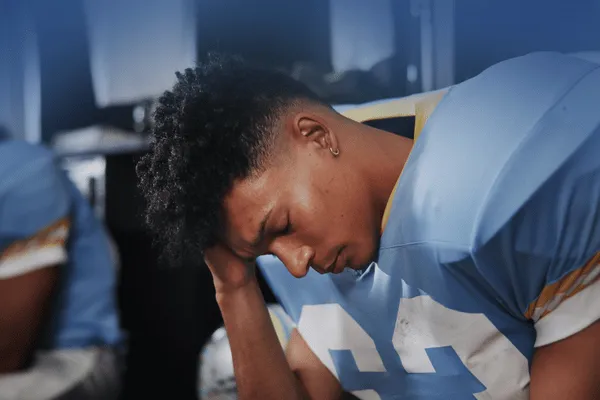
How to Know When Your Athlete Needs a Mental Performance Coach
Most parents wait about a season too long.
Not because they are careless. Because the signs look like other things. Attitude. Laziness. A phase. A bad coach. Puberty. Every one of those explanations is available, and every one of them lets you wait another few weeks.
Meanwhile the athlete is running the same loop, and the loop is getting more practiced.
Here is what to look for, what it usually means, and where the line is between something coaching fixes and something it does not.
When does an athlete need a mental performance coach?
When the gap between what an athlete can do and what they actually do in competition is consistent, and it has stopped closing on its own. The clearest signal is a practice-to-game performance gap that has lasted more than a few weeks and does not respond to more physical training. That is a skills problem, not an effort problem.
The word doing the work in that sentence is consistent. Every athlete has a bad game.
Nine signs it is time
Not all nine. Three or more that keep repeating is the threshold.
1. They are a different athlete in games than in practice. The most reliable sign there is. Everything works Tuesday and disappears Saturday. We wrote about the mechanism in why athletes play great in practice but choke in games.
2. One mistake takes the rest of the game with it. Watch the recovery window. If an error still shows up in their body language three plays later, that is a trainable skill they do not have yet.
3. Confidence tracks the last result. Great game, great week. Bad game, unrecognizable for ten days. Confidence that swings this hard is not confidence, it is momentum, and momentum runs out at exactly the wrong time.
4. They have stopped taking risks. No big errors and no big plays. The tentative athlete is often read as a smart athlete. Usually they are playing not to lose, which is fear of failure wearing a respectable outfit.
5. Physical progress has stopped translating. They are stronger, faster, and more skilled than last year, and the results have not moved. That gap is where the mental game is taxing everything else.
A high school wrestler we worked with finished second at the state championships two years running, both times losing to the same opponent in his weight class. He was not getting worse. He had hit a wall that was not physical. After a season of mental performance work he beat that opponent and won the state title.
6. Physical symptoms show up on game day only. Stomach aches, headaches, needing the bathroom repeatedly before competition, absent on practice days. That is a nervous system responding to a perceived threat. See 7 signs your athlete has performance anxiety.
7. They cannot stop thinking during competition. Hesitating on plays they used to make instinctively. Looking to the sideline after every rep. Being half a step slow while being physically fast enough.
8. Big moments are consistently their worst moments. Fine when the game does not matter. Locked up when it does. Pressure is a skill, and this athlete has not been taught it.
9. They have started talking about quitting something they loved. Sometimes this is a genuine change in interest. Often it is emotional self-protection, because "I don't care" is easier to carry than caring this much and hurting.
One more thing about timing. If your athlete is being recruited, or is about to be, the cost of waiting changes. Recruiting windows are short, and coaches evaluate consistency across a season rather than one highlight. An athlete who is excellent in practice and unrecognizable in games is being seen at their worst by the people whose opinion counts most that year.
That is not a reason to panic. It is a reason not to give it another season.
What if my athlete says they are fine?
Take it seriously and keep watching behavior. Teenagers frequently under-report distress to parents, especially about something they believe they should be able to handle alone. Behavior is the more reliable signal: recovery time after mistakes, willingness to take risks, and whether they still talk about their sport at home.
Pushing for a confession rarely works. Noticing out loud, without a verdict attached, works more often.
Something like: "I've noticed the last few games have felt heavy. I'm not asking you to fix anything. I just wanted to say I see it."
That sentence has started more of these conversations than any question we know of.
Three signs it is something else
This is the part that gets skipped, so we will be direct about it.
If distress has left the field, it is not a coaching problem. Sadness or withdrawal that shows up at school and with friends, not just at practice. Sleep or appetite changes that persist. Anxiety that disrupts ordinary life. Those are clinical concerns and they need a licensed clinician first.
If there is disordered eating, self-harm, or any mention of suicide, stop reading and call a professional today. Even if it was said casually. Even if they laughed. Mental performance coaching is not the intervention for this, and any coach who takes that case instead of referring it is the wrong coach.
If the athlete has genuinely lost interest, that may just be true. Not everything is a mental block. Some fifteen-year-olds are done with a sport they started at six, and that is allowed. Coaching an athlete back into something they no longer want is not a service to them.
Amy is a triple board-certified physician — a pediatrician, adolescent medicine specialist, and sports medicine physician — as well as an MGCP and MPM certified mental performance coach. Recognizing which of these three a family is actually in is not an add-on to the coaching. It is the first thing that happens.
Is my athlete too young for this?
Age matters less than willingness. Athletes from middle school on can learn concrete mental skills, provided the material is specific and they are participating by choice. The reliable disqualifier is not age, it is a parent wanting it more than the athlete does.
That last point is worth sitting with, because it is the most common reason this fails.
If you are the one who found this article, that is normal and fine. But at some point the athlete has to want something out of it. It does not have to be enthusiasm. Curiosity is enough. "I'd try it once" is enough.
Compelled athletes do not do the work between sessions, and between sessions is where the change happens.
What to do this week
Three things, in order.
Watch one game without coaching. No feedback, no post-mortem. Just watch what happens after the first mistake. Time it if you have to. That number tells you more than the final score.
Ask one open question on a neutral day. Not in the car after a loss. Something like "what part of the season has been the least fun lately?" Then let the silence do its work.
Take the answer at face value. If they name pressure, that is a mental skills problem. If they name exhaustion or dread that has spread past the sport, that is a health conversation.
Sue, a high school track parent, described what she was actually looking for when she reached out:
"As a mom of a teenage athlete, Amy provides support and guidance physically and mentally to ALL with an informative, yet easy going nature that makes you feel like she's got you."
Frequently asked questions
How do I know if my child needs a mental performance coach or a therapist? Look at where the distress lives. If it appears only around competition and daily life is otherwise stable, that points to mental performance coaching. If sadness, anxiety, sleep changes, or withdrawal have spread into school, friendships, and home, that points to a licensed clinician first.
At what age can an athlete start mental performance coaching? Most athletes start in middle school or later. The requirement is willingness rather than age. An athlete who is participating reluctantly because a parent insisted will typically not do the between-session practice where the change happens.
What if my athlete refuses to try it? Do not force it. Offer something low-commitment first, such as a free guide, a single article, or one conversation with no obligation, and let them decide. Athletes who opt in engage far better than athletes who are enrolled.
Is it too late to start mid-season? No. Mid-season is when the problem is most visible and most motivating for the athlete. Skills like resetting after mistakes and building a pre-performance routine can be trained during a season without disrupting it.
Can a mental performance coach work with my athlete's regular coach? Yes, and it usually works better. Mental performance coaching is designed to fit into an existing program rather than compete with it. Victory Performance also offers team coaching that trains a whole roster in the same language.
Not sure which one you are looking at?
That is the normal place to be, and it is exactly what the free consultation is for.
Thirty minutes. No charge. We will listen to what has actually been happening, tell you whether this is a skills gap or something that needs a different professional, and give you a straight recommendation either way.
If it is not us, we will tell you who it should be.
Book a free 30-minute consultation · Or call or text (757) 863-1349.
About the author
Dr. Amy Thompson is the founder and head coach of Victory Performance. She is a triple board-certified physician — a pediatrician, adolescent medicine specialist, and sports medicine physician — and a certified mental performance coach, holding both the Mental Game Coaching Professional (MGCP) certification from Dr. Patrick Cohn and the Mental Performance Mastery (MPM) certification from Brian Cain.
She ran cross country at the University of California, Berkeley, competed internationally as a figure skater, and trained at the U.S. Olympic and Paralympic Training Center in Colorado Springs. She has coached athletes from middle school through the professional level.
Instagram
X
Youtube